
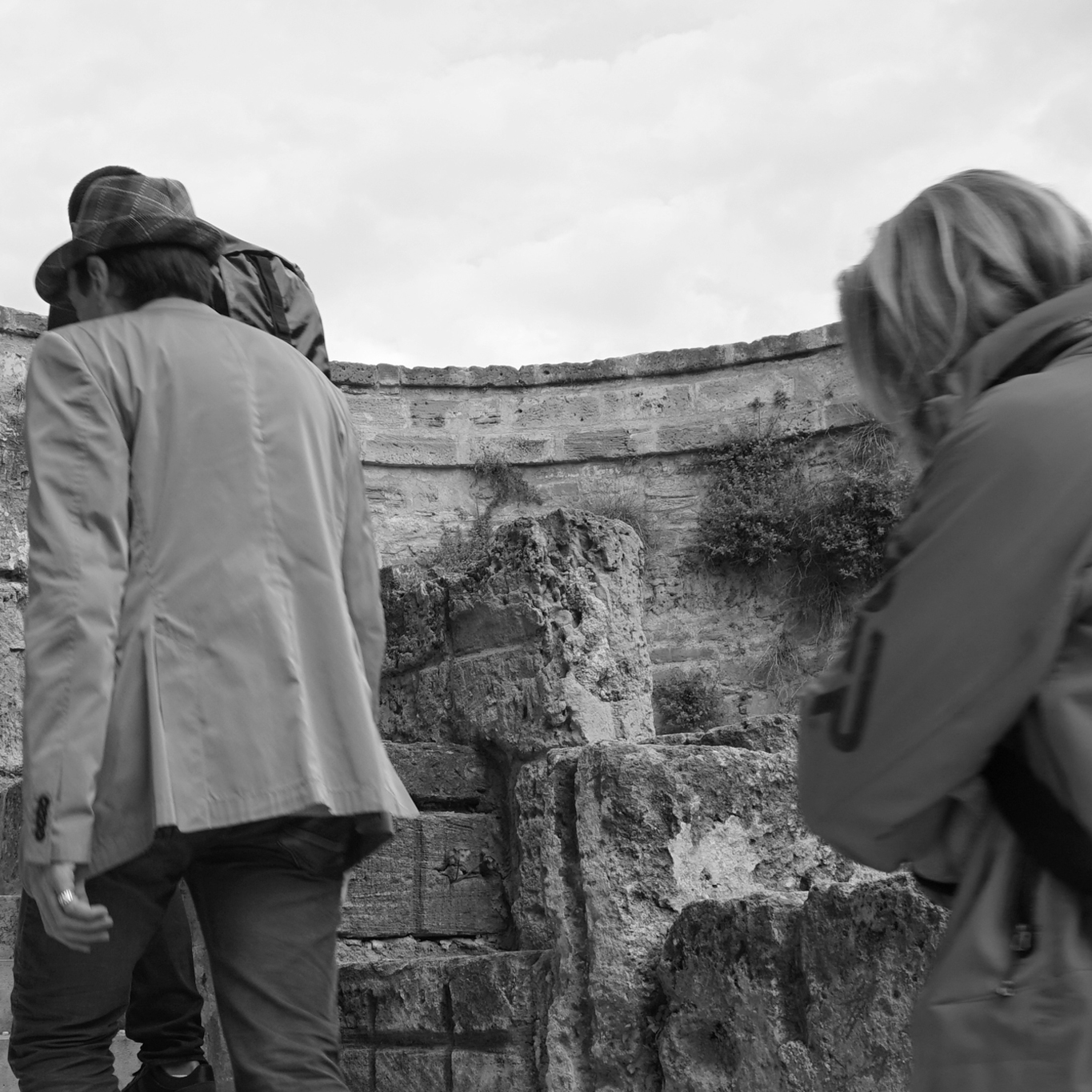
Walking Festival of Sound is a transdisciplinary event
exploring the role of walking
through and listening to our
everyday surroundings.
It combines a number of free
and public events including
walking performances, walking
seminars and listening sessions, all taking place in
diverse public spaces and online.
Walking Festival of Sound
facilitates a meeting point for
the international network of practitioners
and researchers interested in sound and walking.
Through diverse events we explore how walking and listening practices
can augment and challenge the way we perceive, navigate through, and care for our shared environments.
In 2019 the festival took place in two cities, Stockholm, Sweden and Newcastle upon Tyne, UK.
In April 2021, the festival moved to Krakow, Poland and Edinburgh, Scotland.
In 2022, the festival visited Seoul, Korea and Vancouver, Canada. Zurich, Switzerland, was the festival's site in 2024.
In 2026, the festival takes place in Boston and Cambridge, USA.
The festival
was founded and is directed by
Jacek Smolicki and
Tim Shaw
We welcome partners, donors and sponsors to support the festival and its future editions. Please, get in touch via email at info[at]wfos[dot]net.
Origins and philosophy of WFoS
The origin of the festival was serendipitous. In 2015, we — sound artists and researchers Jacek Smolicki and Tim Shaw — met on a soundwalk in Vancouver, led by a member of a local soundwalking collective, during the International Symposium for Electronic Arts. Amid a programme thick with screens and blinking lights, that quiet, technology-free walk stood out to both of us, and the conversation that followed, over a meal, turned into plans for a collaboration. What followed was a residency at ARC in Romainmôtier, a quaint and tranquil village in the Jura Mountains, that proved pivotal. Named Walk and Talk, the residency made room for developing the idea further, giving us the time and distance to start sketching its potential format: a city-wide festival with multiple starting points, bringing together practitioners who attend to sound and listening as a gateway that might lead somewhere that has little to do with sound directly, like questions of history, ecology, politics, technology, spirituality, and more.
The format we arrived at was simple, and deliberately at odds with some of the tropes many sound art festivals fall into — heavy infrastructure, unsustainable travel, and short visits by touring artists that leave little behind. Instead, we keep the festival's scope local, rooted in each city's own communities and cultural scene. Instead, it is the framework itself that travels; the people who present and share work within it are typically already rooted in the place, carrying a deep relation to it. They don't have to be sound artists, nor work with sound as their medium. Throughout the years, we have collaborated with people and researchers, environmentalists, activists, city planners, historians, archivists, librarians, community leaders, who hadn't worked with sound but for whom that medium and the act of listening enabled a more embodied and experiential transmission of their work and knowledge to a broader audience. Our role hence in such cases is to suggest sound and walking-based methods, techniques that their work might benefit from, to create room for an exchange of viewpoints — and listening positions — that might grow into future collaborations and projects. Because each edition means relocating anew, we also work closely with local curators and other actors to get in tune with the city; we don't presume to know a place, and leave as much room as possible for local actors and invited presenters to shape it, giving them little more than a time and a place and trusting them to find their own way into listening. That means each edition demands a fair amount of research, but it's research we see as benefiting not just that year's programme, but the wider network the festival germinates in every city it visits. And because the festival is, at its core, about walking and listening, we don't need to lean on venues and institutions as the only places where things happen. We want to be as outdoors and open to the public as possible, on the belief that art, culture and knowledge should be accessible beyond institutional walls, gallery spaces, and their bureaucratic mechanisms — even as we maintain fruitful relationships with institutions both large and small, community-driven ones among them. It's the nature of walking, moving, operating in between, that shapes our thinking, ways of living and connecting with the world, also outside our activities as curators, researchers and artists. And it's something we want to keep cultivating as the festival's modus operandi. Otherwise, the space for serendipitous encounters, like the one that brought us together in the first place, would be limited.
Since its first edition in Stockholm and Newcastle upon Tyne in 2019, the festival has followed a broadly biennial rhythm, unfolding city by city: Kraków and Edinburgh in 2021, Vancouver and Seoul in 2022, Zurich in 2024, and, most recently, Boston and Cambridge in spring 2026 — its biggest edition thus far, with a dozen or more institutions involved and nearly 20 events, hosted with Harvard's ArtLab.
These encounters point toward something bigger than a biannual event, for us: not soundwalking as a bounded artistic exercise, but walking and listening as an everyday way of being in — and taking responsibility for — the world around us.
Contact us by sending an email to info[at]wfos[dot]net
Diligently supported by: friendliness, conviviality, mutuality, and insubordinate forms of cross- and non-institutional attentiveness.
WFoS 2019 was funded by Newcastle University Institute for Creative Arts.
WFoS 2021 was funded by European Cultural Foundation's Culture of Solidarity Grant.
2021 events were also facilitated thanks to Jacek Smolicki's postdoctoral artistic research funded by the Swedish Research Council between 2020-2023.
WFoS 2022 was funded by Vancouver New Music and Arts Council Korea.
WFoS 2024 was funded by The Collegium Helveticum, the joint Institute for Advanced Studies (IAS)
of ETH Zurich, the University of Zurich, and the Zurich University of the Arts.
WFoS 2026 is supported by Harvard ArtLab, Harvard Graduate School of Design,
Loeb Fellowship, Harvard Arnold Arboretum, Harvard Shelemay Sound Lab.
Design: Jacek Smolicki / Ekoton Studio