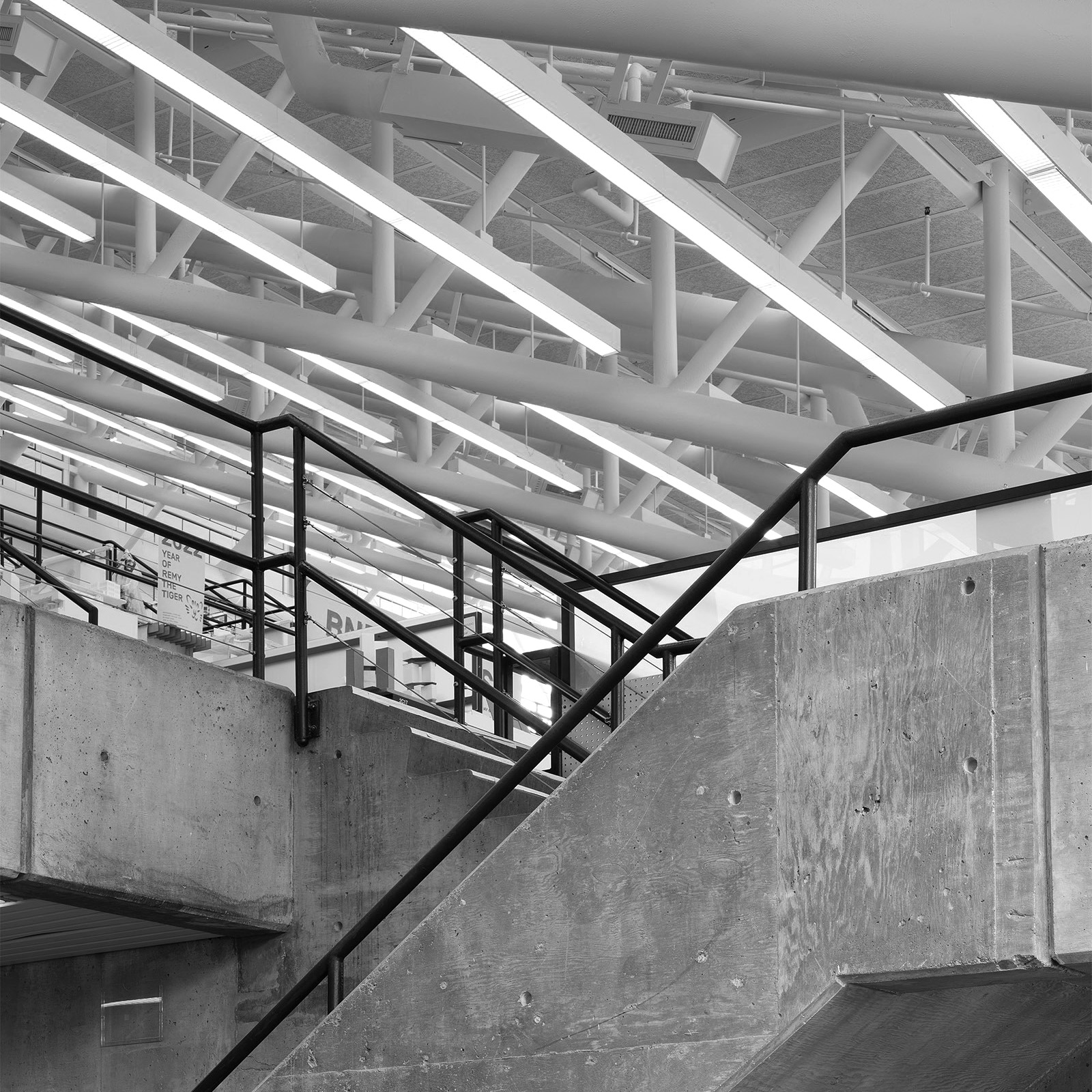
image credits: Noritaka Minami
Soundscapes of Gund Hall
Located on the railing between Chauhaus and the Mezzanine of Gund Hall
How can you draw sound? Why would you draw sound?
In these drawings students translated their acoustical experiences of specific places in Gund Hall into visual compositions. In each case, they invented marks – and sometimes methods – to convey essential and specific aspects of those spaces. They worked in partnership so that they could compare their experiences, and they extended their auditory inquiries over time by making drawings that face both the Chauhaus and the Mezzanine.
The extended and collaborative nature of the auditory inquiry reveals rationales for making this project part of a drawing course in a Design curriculum. Designs are often arrived at collectively, and site visits are an important part of an ideation process. Listening to a place sharpens students’ skills in perceiving various aspects of a site. Audible sounds depend on the spatial dimensions of a void, on the materials at the boundaries of that void, and on the contextual conditions that surround a specific place. Many students heard street sounds, for instance, and became freshly aware of the height of a ceiling or the material qualities of solid concrete vs. hollow metal.
The class prepared for this midterm project when Loeb Fellow and sound artist Jacek Smolicki brought his auditory equipment and expertise to class, as he guided us toward hearing and drawing diverse soundscape recordings. Also, improvisational percussionist Richie Barshay “played the room” and created an orientation toward listening more openly and perceptively.
In a 1930s film, when an artist tries to sum up the impulses of modern art, he says, “We don’t paint the whistle, but the ––” he stops speaking and instead makes the sound of a whistle. As students at the Graduate School of Design are studying modernist traditions and legacies, this project takes their explorations in sensory direction, one that can enrich their future endeavors. Meanwhile, we hope that these drawings engage your curiosity about the spots in Gund they are depicting, as well as about awakening your senses to whatever spaces in which you find yourself.
Karen Schiff
GSD Lecturer, “Drawing Space / Marking Sensation”
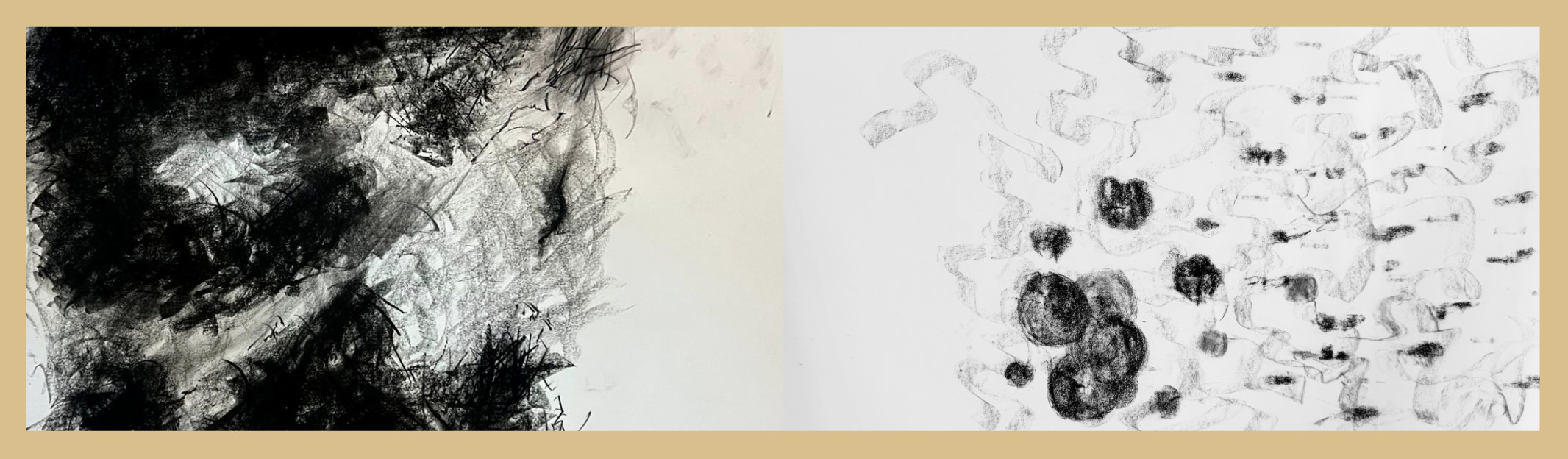
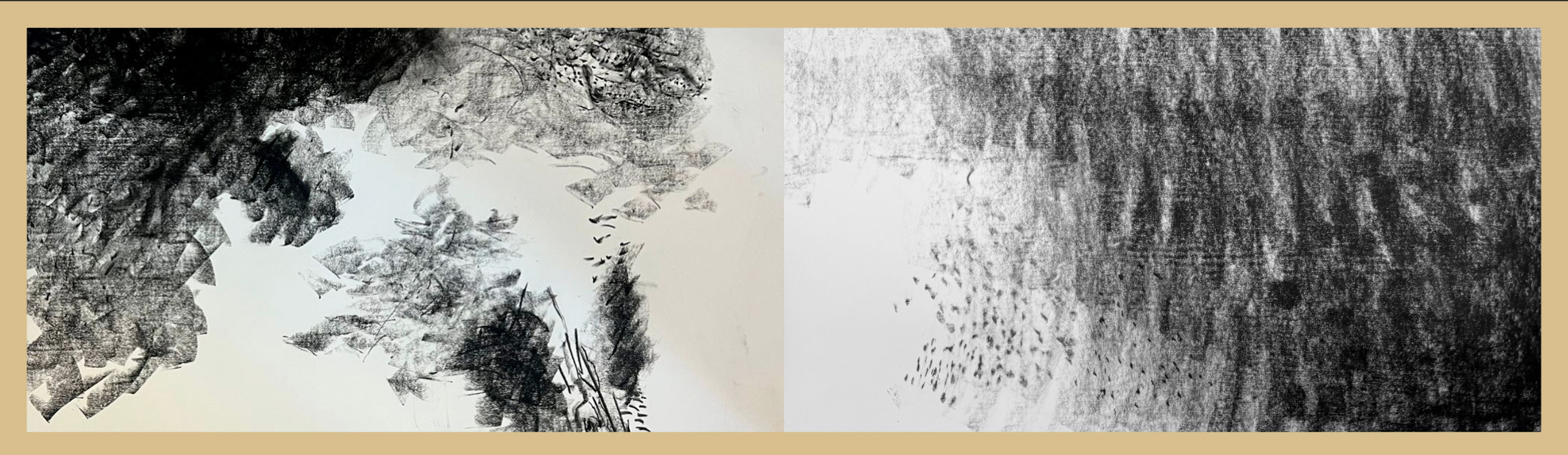
The Column Between
Valentina Sarcinella Mariotto and Zamen Lin
Location: Chauhaus, first floor
These drawings try to capture the moment when sound splits into separate territories.
In these diptychs, we focused on a massive concrete column located at Chauhaus.
Sitting side by side but separated by this mass, we drew simultaneously what we heard.
Though physically close, the column turned the room into distinct acoustic territories.
On a weekday morning, the drawing facing Chauhaus on the right depicts the clinks of pans
and trays with music drifting in the background, while the other, on the left, registers harsher
frictions and the hum of coolers and vending machines. On one side, Chauhaus breathed in soft
layers, on the other, it broke into dense notes. On a Sunday night, the division deepened and
the room thickened, as sounds pooled into darker masses, represented by the drawings facing the
Mezzanine. All these drawings try to represent that strange acoustical truth, that a place can
never be fully shared. Listening always formulates your own personal space.
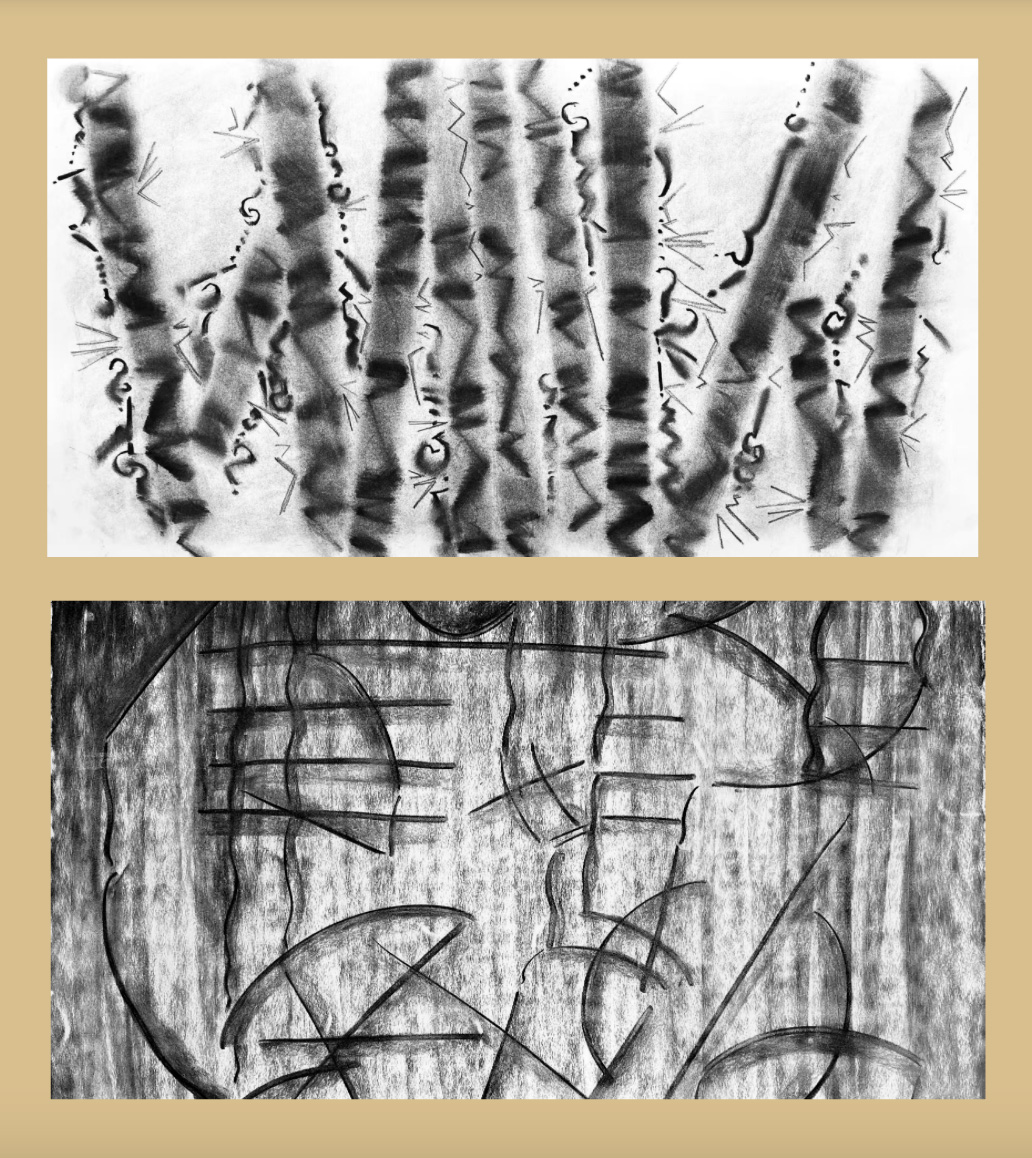
Words and Machines / Broken Silence and Collaboration
Wenhao Yan and Haiyi Zong
Location: Printing machine space, third floor
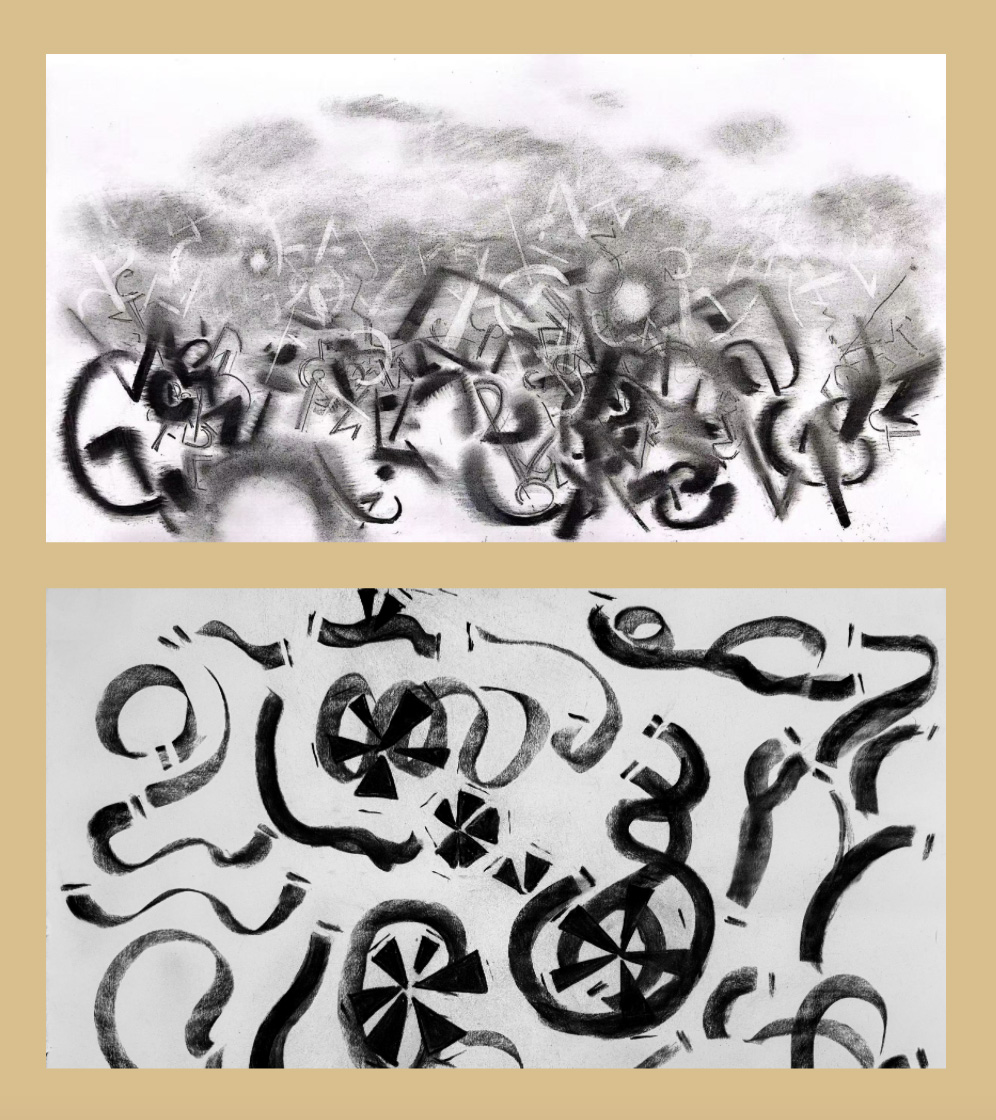
Words and Machines, Wenhao Yan: This space is the small hall on the third floor of Gund Hall, where the OCE printer and the drinking fountain are located. Although it is not large, it is always full of different kinds of sounds because people constantly come here to print and get water. During midterms or finals, the sound of the printers runs almost nonstop. At other times, conversations become the dominant noise. My two drawings represent these two different states. One (facing the Chauhaus) depicts the printers working day and night, with the mechanical noise mixed with the rustling of paper and tense conversations. The other (facing the Mezzanine) shows a quieter moment, when people are more relaxed and many conversations take place in the space, so I tried to draw the sound of words themselves.
Broken Silence and Collaboration, Haiyi Zong: In this space, an OCE printer, a drinking fountain, a coffee machine, and a microwave coexist, and people’s activities revolve around these physical machines. The laughter and chatter of people intertwine with the hum of the printer, serving as a testament to daily life. These two drawings help capture these moments. One (facing the Chauhaus) depicts a typical morning during the pre-final period, when a person enters the space and breaks the silence; the other (facing the Mezzanine) shows lunchtime and dinnertime, when people gather to chat and laugh while waiting for the printer and microwave to finish their tasks.
Hum and Interruption / The Pit
James Musasizi and Julia Mattis
Location: Gund 110 (The Pit), first floor
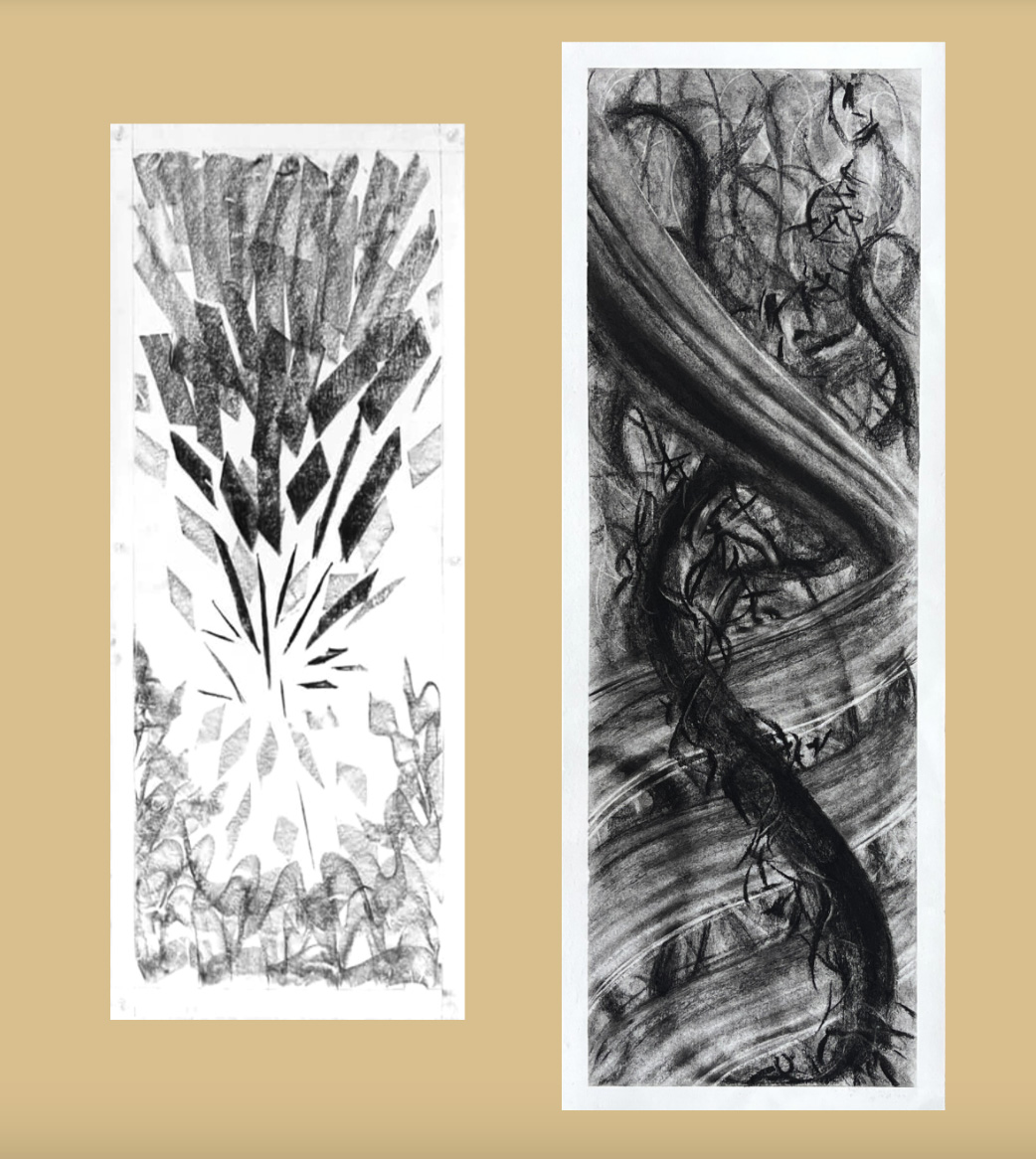
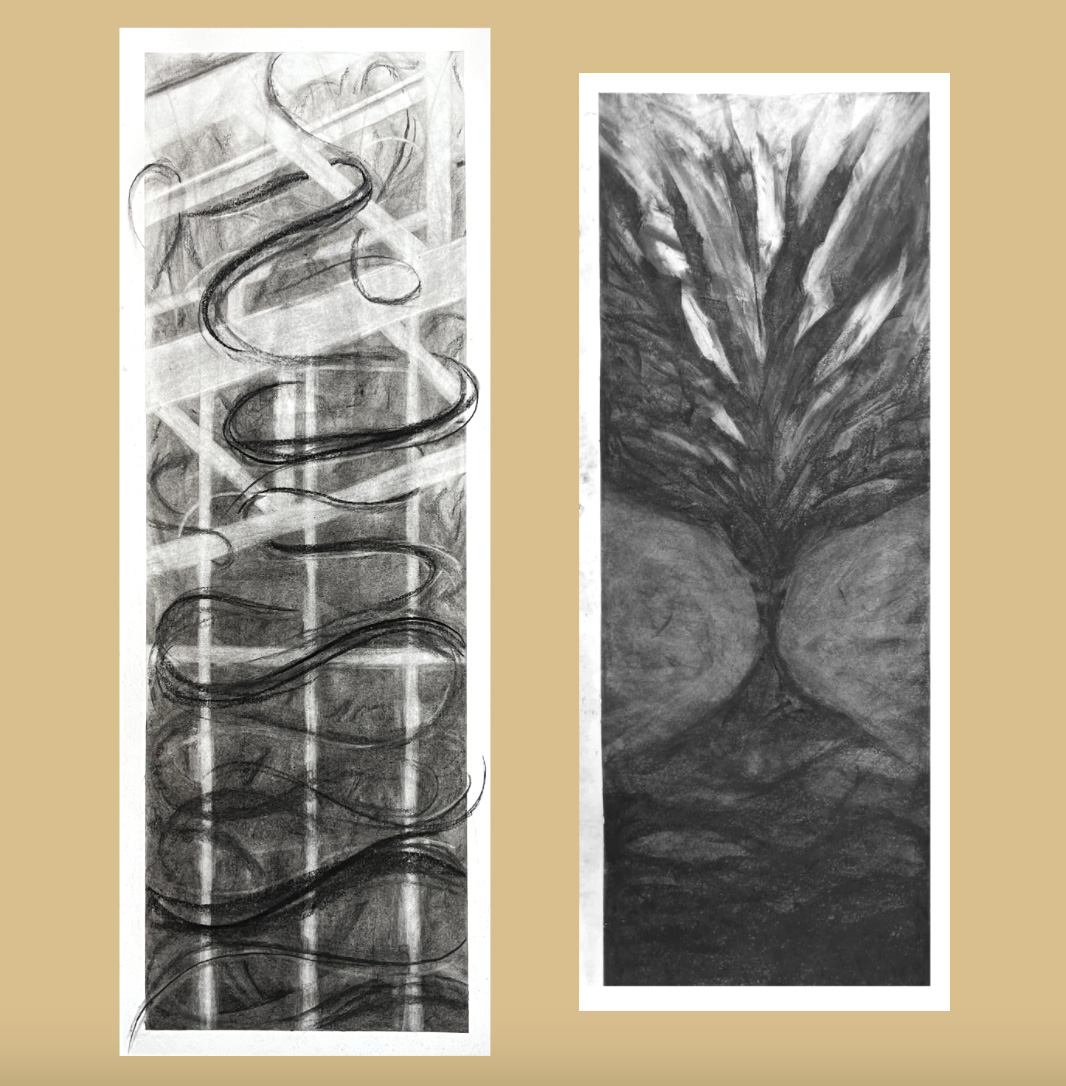
James Musasizi: Narrative text: These two drawings (located closer to the stairs) both depict the soundscape of the stairway in the Pit, but from two different listening positions that produce distinct acoustic readings of the same space. In the drawing facing the Chauhaus, the listener stands at the base of the stairs, where the ambient mechanical hum recedes and individual sounds become more legible. Conversations from the trays, footsteps on the stair, and bursts of chatter are registered as sharp, radiating marks that punctuate the field as people move through the space. In the drawing facing the Mezzanine, the acoustic experience shifts. The ambient hum from the radiators becomes the dominant ground condition, represented as a dense, dark field from which lighter shards of sound emerge. Here, the movement of bodies on the stair briefly sharpens voices and noises from the Trays before they dissolve back into the surrounding acoustic atmosphere.
Julia Mattis: My drawings (located closer to the windows) aim to capture the whirring sounds from the radiators that rise through and fill the space, rendering the base layer of human chatter a dim hum. The resonance of the heating system muffles sharp and sudden sounds – the abrupt clack of heels running up the concrete stairs, the constant clicking of numerous keyboards, and the jarring sound of someone dropping their materials – pushing them into a middle ground that is detectable yet inconspicuous. The two drawings layer the textures of the sounds from the Pit as they interact with the open-ceilinged verticality of the space.
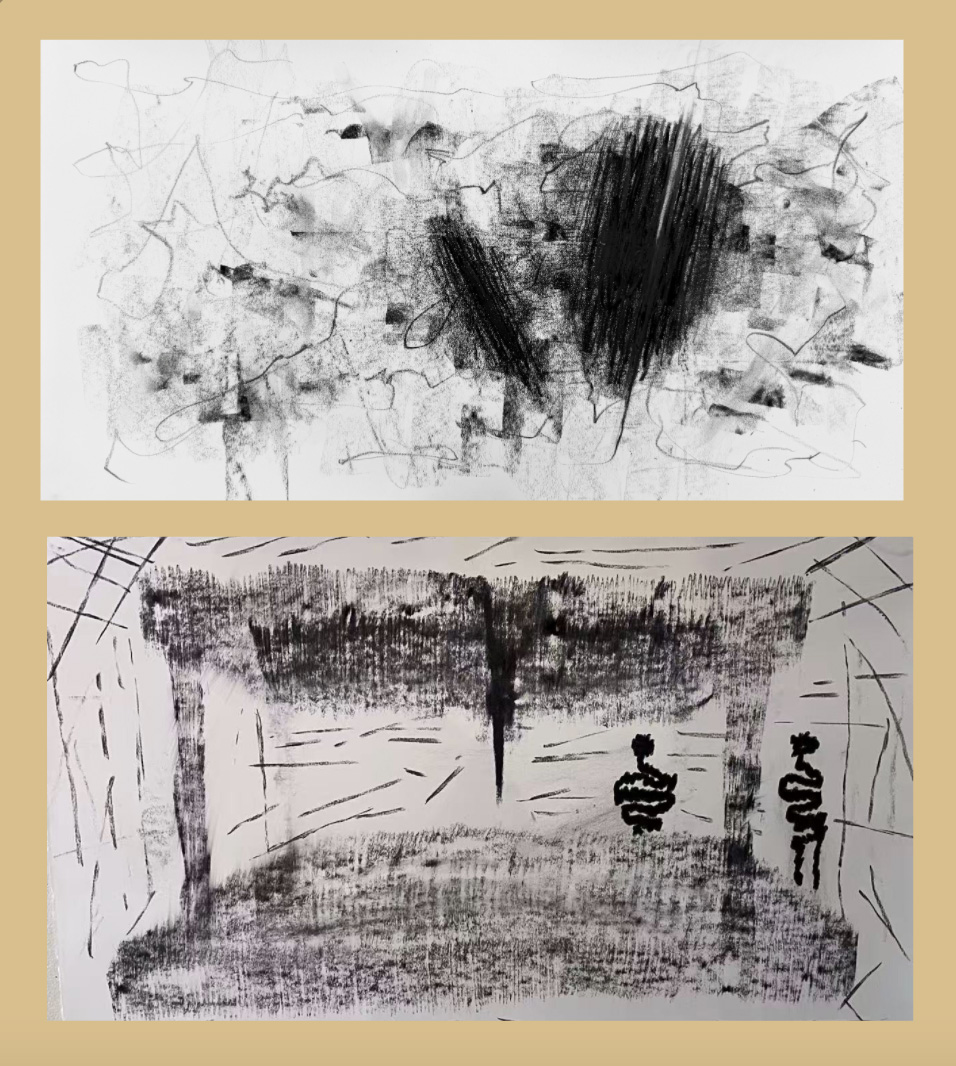
Milling / Between Voices, Humming, and Machine Noise
Xinhang Xu and Jiaxin Yan
Location: Basement, outside the CNC room
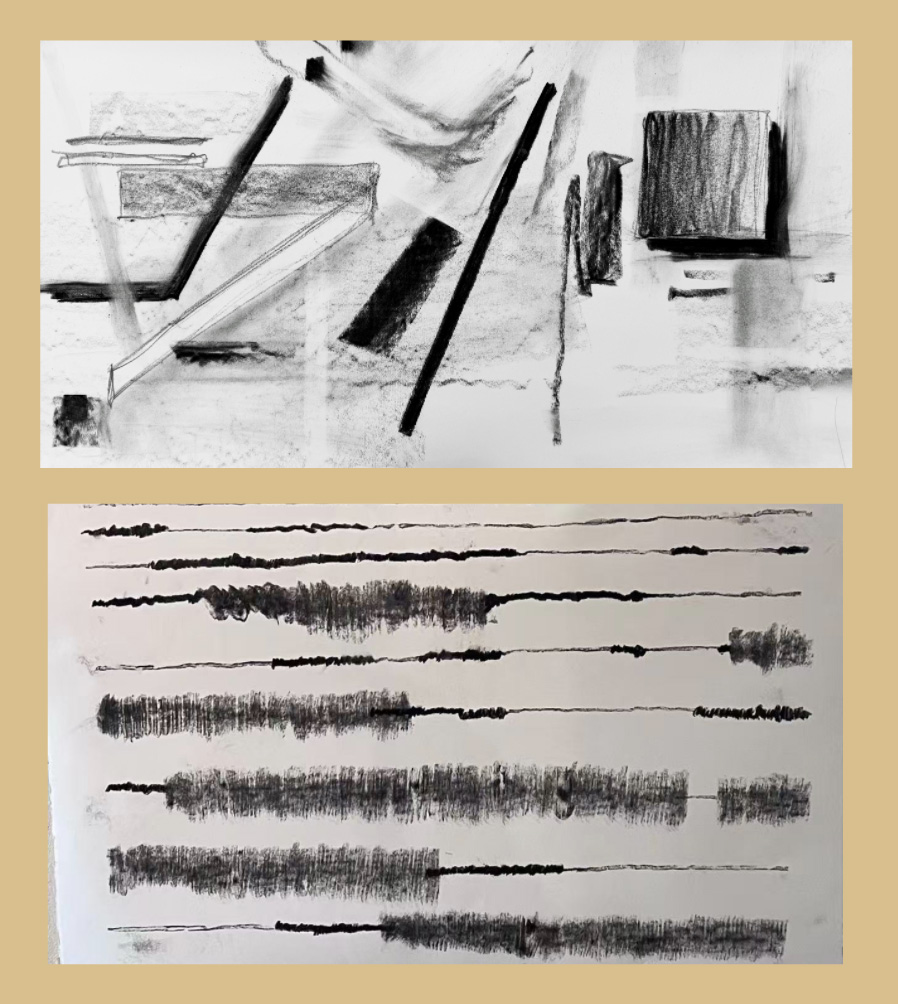
Xinhang Xu: These two drawings (located higher up) both depict the acoustic environment during CNC machine operation, but use different representational approaches. In the first one (facing the Chauhaus), machine noise, ventilation, and human voices are expressed as color blocks, whose size, shape, intensity, and overlap convey their relationships; the upper-right area appears as a projected square but is actually an overlay of a light gray gradient and a dark L-shaped block. In the second (facing the Mezzanine), different sounds are represented by distinct marks: light gray volumes indicate ventilation, trembling lines suggest human voices, and the darkest areas correspond to the CNC machine, with boundaries between them sometimes blurred and sometimes clearly defined.
Jiaxin Yan: The drawings (located lower down) represent the sound environment inside the CNC room while people are working. The drawing facing Chauhaus, records the sound traces produced during CNC room operation. The more dramatic the fluctuation of the lines, the louder the sound in the space. Different types of brushstrokes also correspond to different sounds. The finest stroke represents the constant humming sound when the machine is not running. A slightly heavier stroke represents human voices in the room. The widest and darkest stroke represents the sound of the machine in operation. The drawing facing the Mezzanine, uses the same brushstroke logic to describe the spatial relationships within the room. It shows where people and machines are located in the space, as well as where the different sources of sound originate.
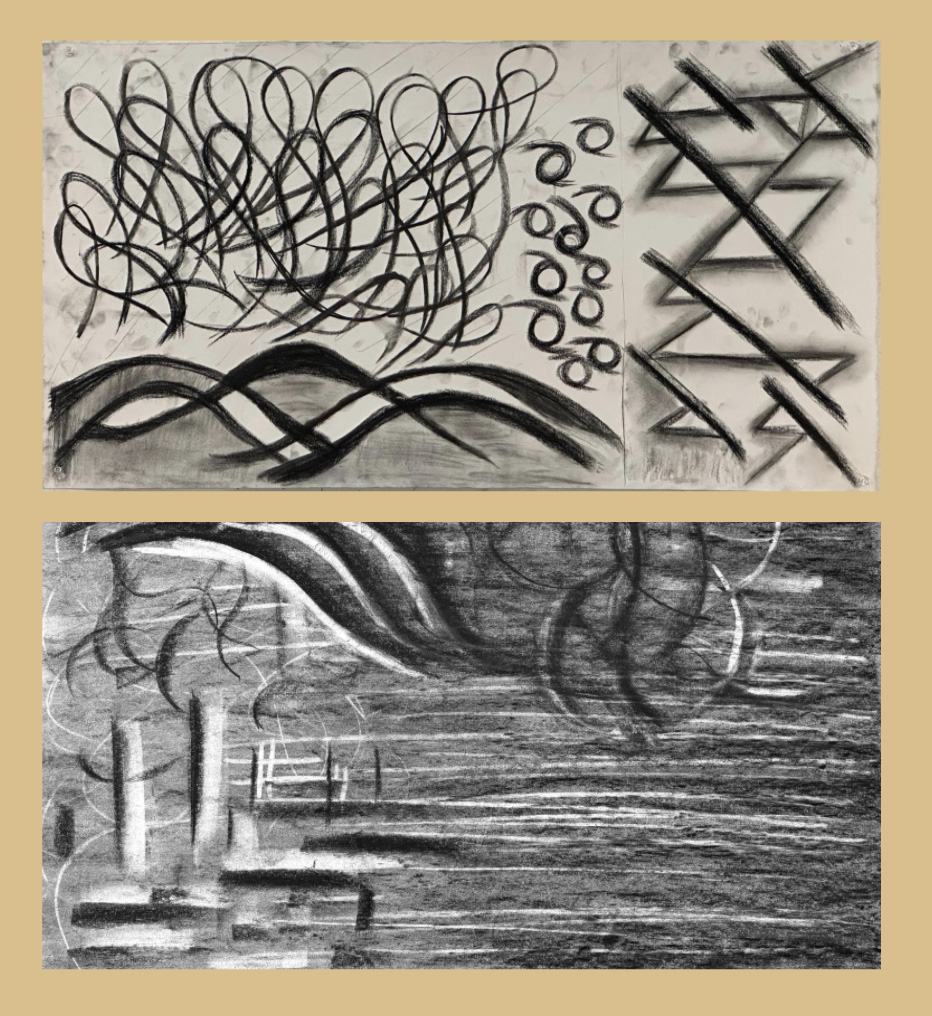
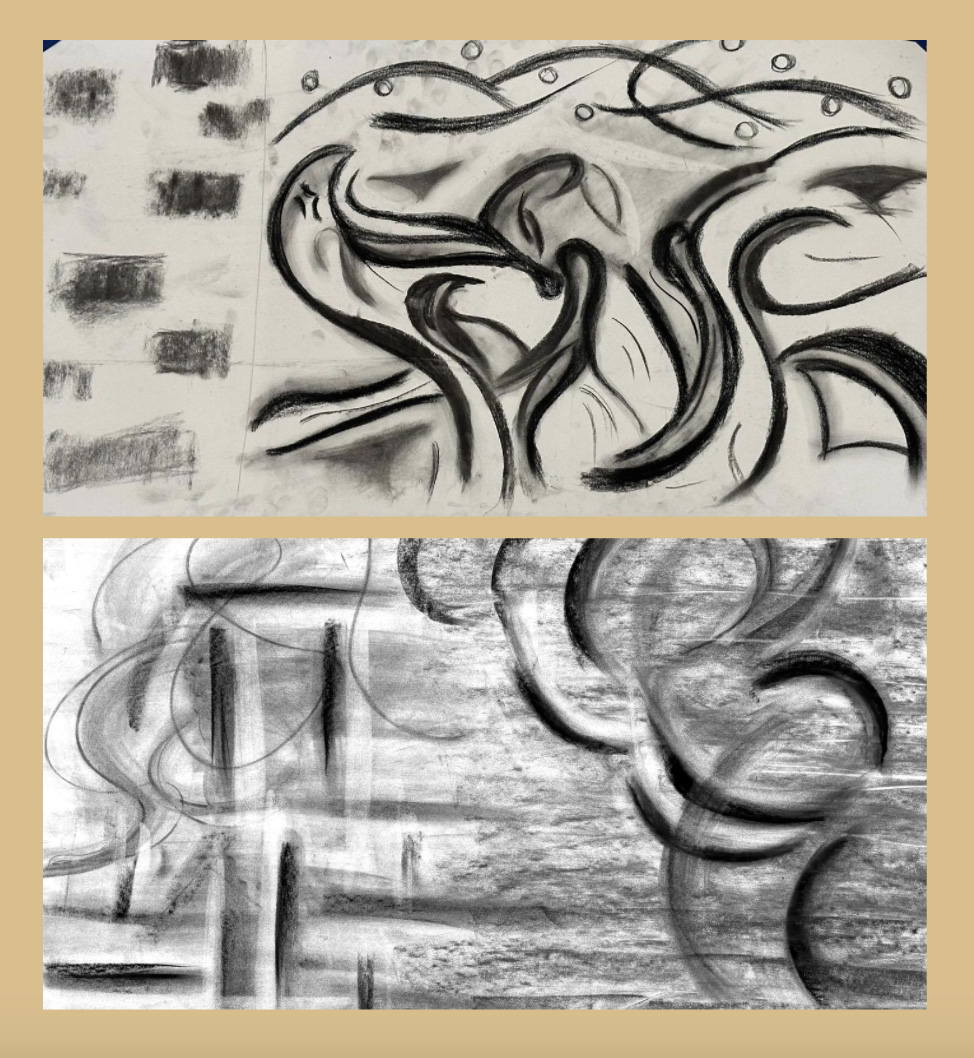
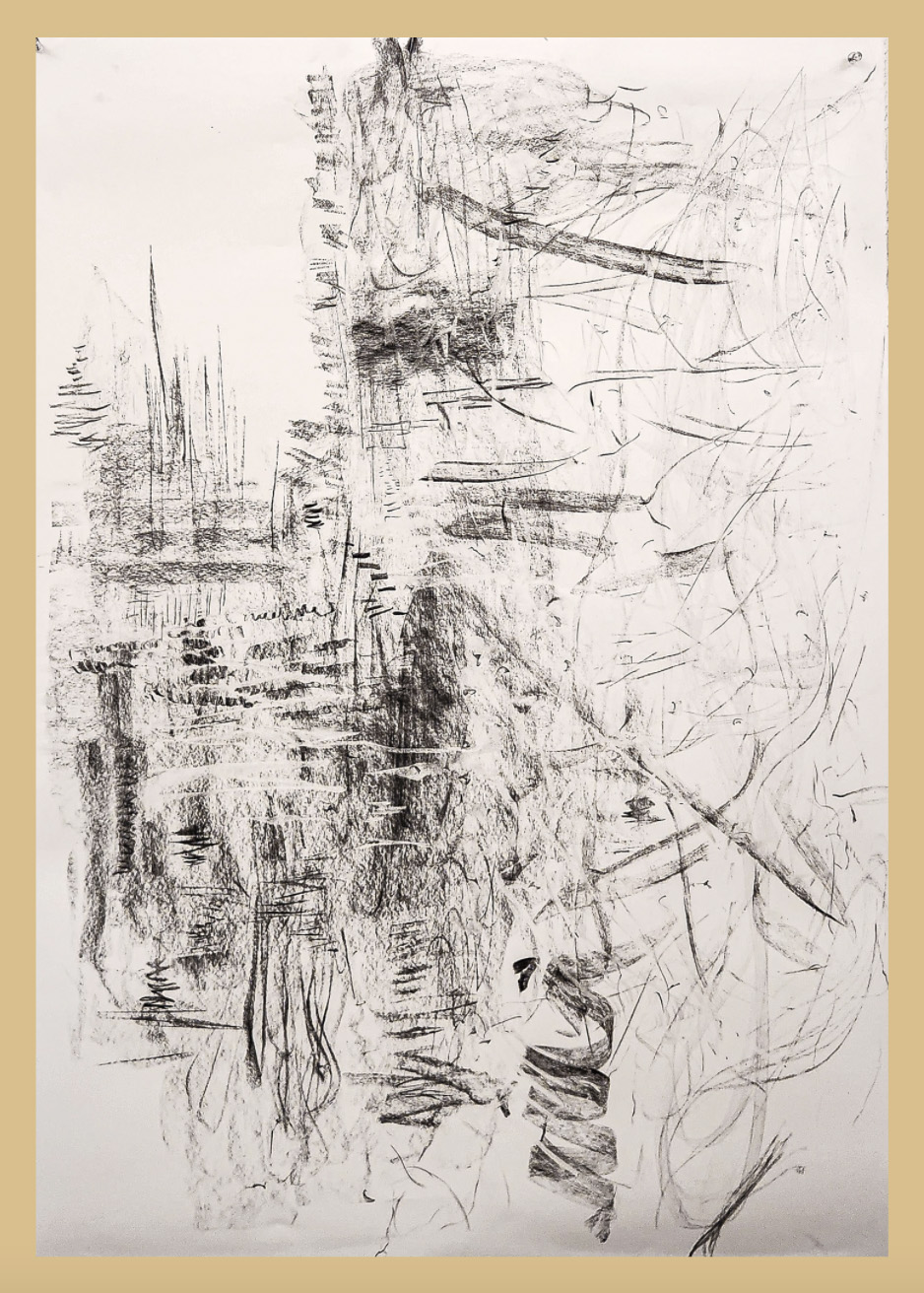
Four Moments
Joanna Ho and Gulsah Aygun Orhan
Location: Outer Tray, next to the outdoor area along Cambridge Street, third floor
Joanna Ho: In my drawings (located higher up), the recording location at 9am and 1pm is reflected in a deliberate visual division between indoor and outdoor marks. Continuous, overlapping strokes represent the layered soundscape inside of Gund Hall: conversations, Chauhaus preparation noise, laughter, and objects falling to the floor. Despite this density and diversity of sound, the marks share a consistent quality — omnidirectional, blended, and simultaneous. Occasional sharp notes punctuate the continuous texture (illustrated through the occasional sharp note), while the peripheral vantage point introduces a sense of clarity and acoustic distance from the hall’s activity.
Gulsah Aygun Orhan: In my two drawings (located lower down), created at 5pm and 9pm, I developed a method of representing sound as layers, where time itself became layers of texture. Distinct sounds were indicated through stronger marks, while quieter moments were blended into textured fields. Human and mechanical rhythms were distinguished with curved and straight marks. Listening across the floors and toward the street, the most prominent sonic events are highlighted by using the erasing method.
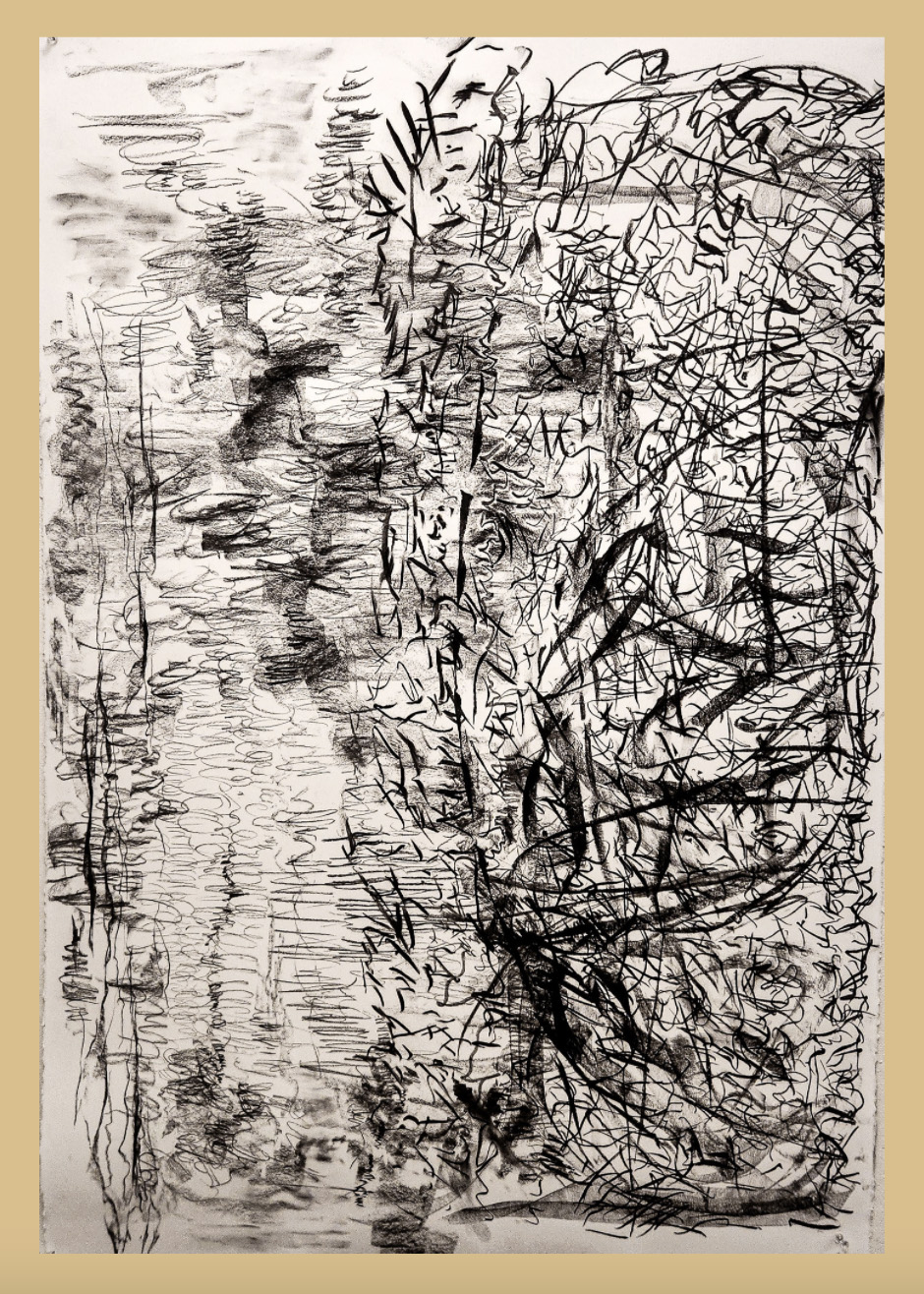
Polyphonic Conversations
Michelle Li and Sean Skaskiw
Location: Piper Auditorium, first floor
These students created collaborative drawings; similarly, their project statements were combined into a single text.
Piper Auditorium is a space that gathers people to exchange ideas. Responding to this atmosphere, we drew on the same surface. The drawing becomes a dialogue—negotiations between two people inhabiting the same acoustic and paper space. Interactions between the artists became like the interactions between audience and speakers during a presentation, a class, or a ceremony.
For the drawing Piper Awake, facing the Chauhaus, we sat in the balcony and responded to the sounds of the Unsung Hero book ceremony on March 13, 2026. Voices gathering in waves. The hush before opening remarks. A microphone hum vibrates, reverberates, settles. A sequence of speakers: some slow and deliberate, leaving sweeping strokes, while others scrawling loops. The swell of applause becomes a textured, tonal wash. As the field of marks accumulated, they began to mimic, interrupt, overlap, and obscure one another.
For Piper Asleep, the drawing facing the Mezzanine, we occupied Piper when it was completely empty, and drew from the ground floor. Given the absence of sound and audience, we worked asynchronously: we both spent time playing the room, tapping on the walls and railings, moving the curtain, and creating other noises for the “audience of one” to record, creating our own “call and response” in a manner not so unlike the “call and response” heard and felt during a more public event. What began as two separate acts of listening unfolds into a shared, improvisational choreography.
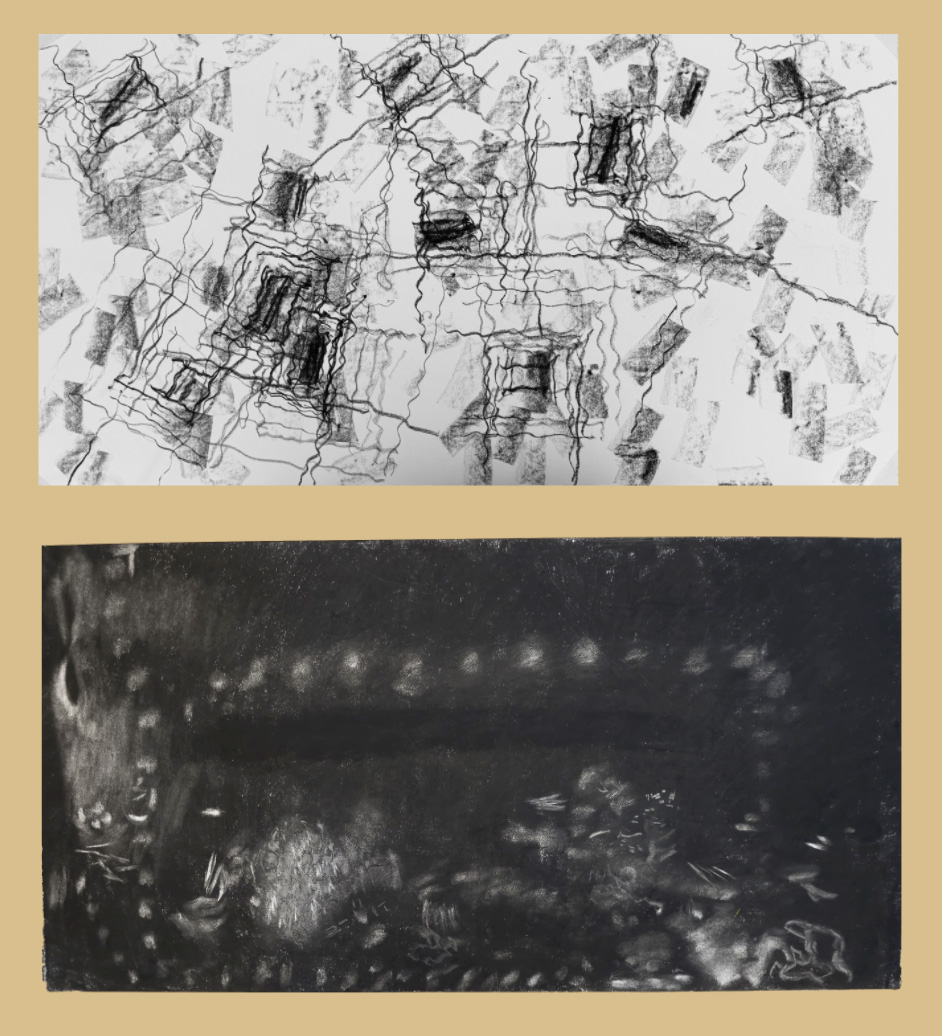
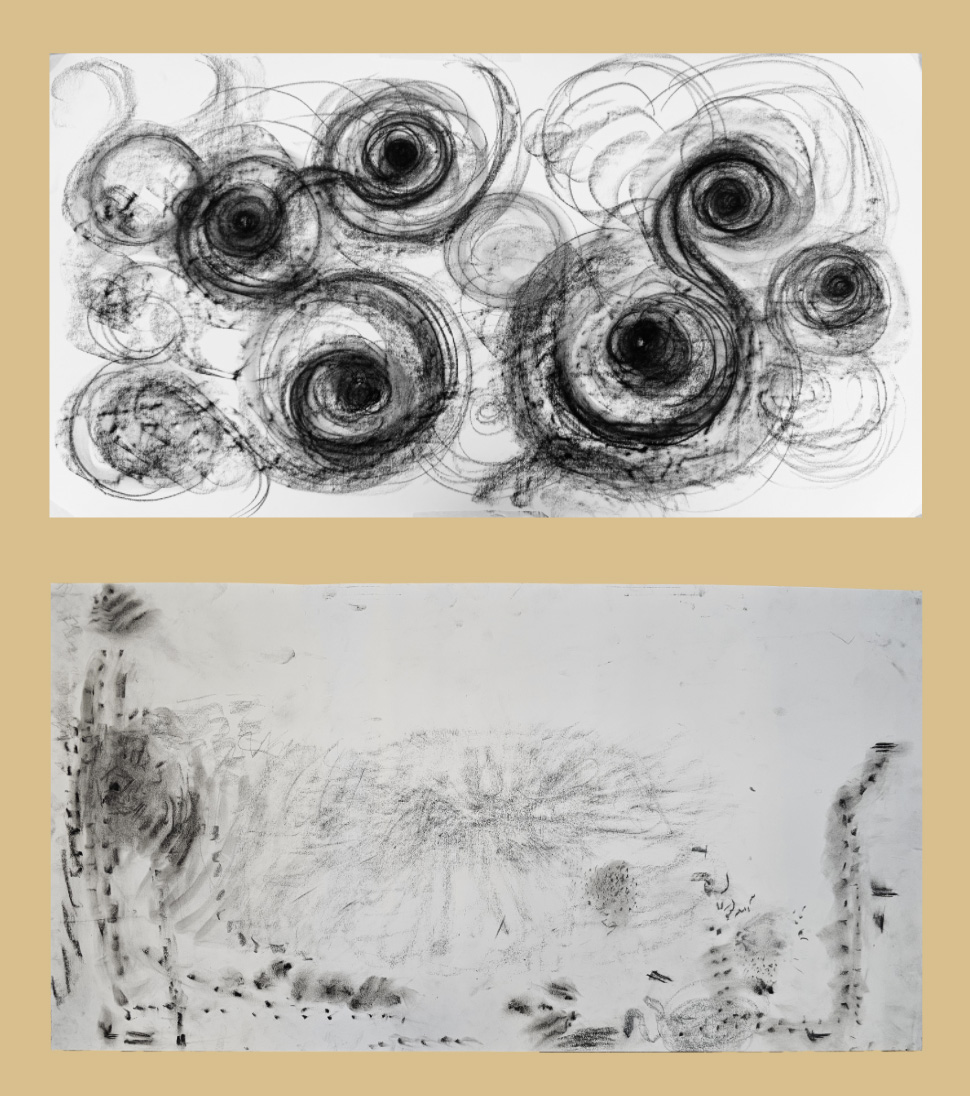
Sounding the Corridor / Presence
Clemence Zhang and Zachary Hicks
Location: Corridor next to the MArch Core Studio space, second floor
Sounding the Corridor, Clemence Zhang: These two drawings (located higher up) document the soundscape of the corridor beside Gund Hall Studio Tray. For the drawing facing the Mezzanine, I simply listened — to voices dissolving in the air, the faint hum of machines, the rustle of paper, the echo of footsteps. The spiraling, overlapping marks follow sound as it disperses: loose, breathing, unresolved. White space is not absence, but where sound has just left. For the drawing facing the Chauhaus, I knocked on walls, touched iron shelves, pressed the floor — forcing silent materials to speak. Each surface confessed its own sonic logic. The marks hardened in response: angular, fractured, abrupt as the collisions that made them.
Presence, Zachary Hicks: These soundscapes are representations of ambient noise that circulate daily through the second-floor office corridor adjacent to the Core Studio space. The two drawings (located lower down) display the locations, frequency, and changes in sounds over 2 hours, on different dates. The marks representing the sounds are composed on the paper in site plan view. For the drawing facing the Mezzanine, more students were present, and their human sounds dominated the space, with mechanical noises lingering softly in the background. During the drawing facing the Chauhaus, fewer students were present, allowing mechanical noises to foreground and define the atmosphere. The space between sounds became more present and the textures of resonances, both soft and pronounced, could be felt filling the space.
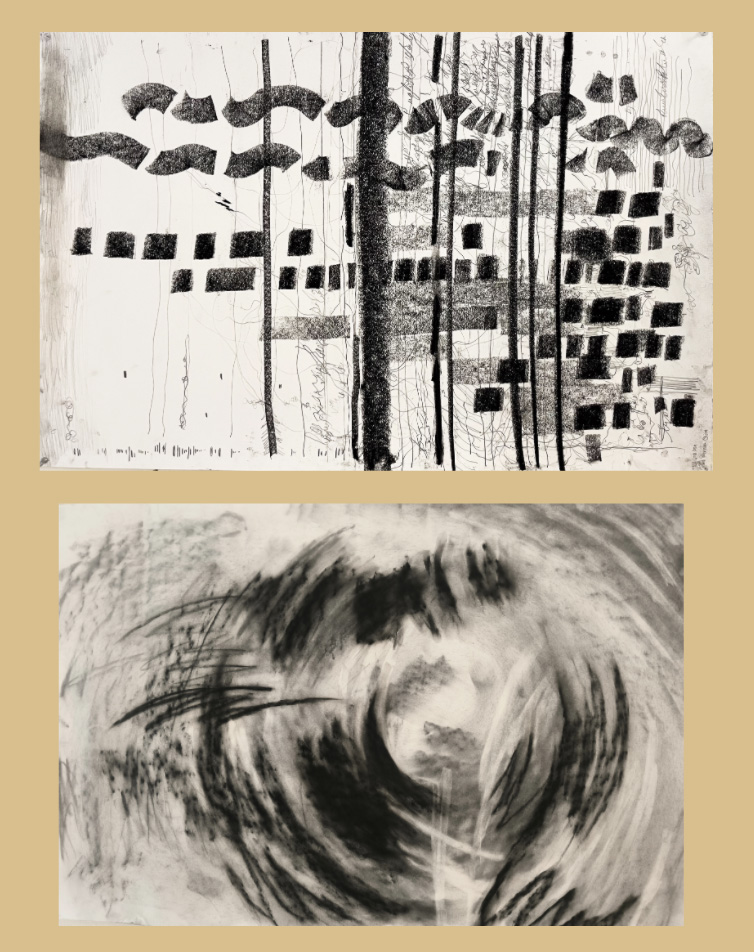
Echoing Space
Gina Qiao and Muxi Zhuang
Location: between the printer and the elevator, third floor
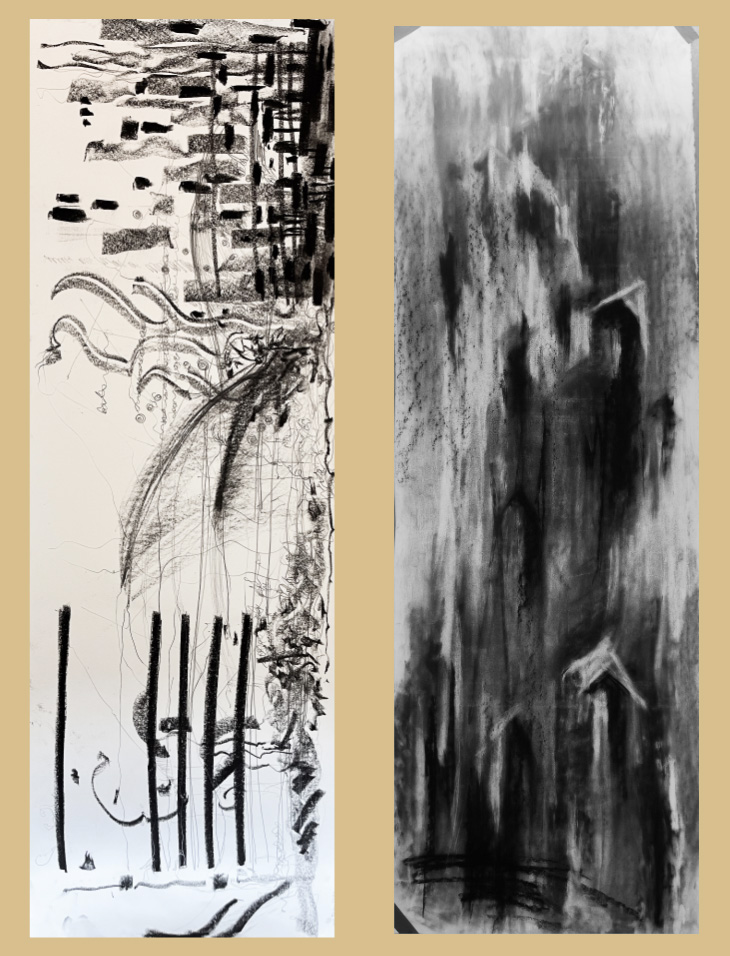
This project depicted both sound on one floor and in an elevator shaft, so it is unique in that it contains both horizontal (plan-like) and vertical (elevator-like) drawings.
Gina Qiao: In this project, three-dimensional volumes of acoustical space are flattened onto the two-dimensional plane of paper. Each sound is translated into distinct marks and lines, based on information such as its frequency, timbre, and even the trajectory of its source. These elements exist independently yet remain intricately interwoven. Within this framework, the soundscape is simultaneously inscribed across both temporal and spatial vectors; the movement of objects and events—along with the flow of time and shifts in perspective—are presented together through the medium of paper, coalescing into a visual symphony.
The printer sits to my front right, intermittently emitting a rhythmic sound; the paper cutter is behind me to the left, yet its distinct, slicing sound cuts across a vast expanse of air. Bridging these two spaces are the sounds of people conversing, along with the wave-like rustling of massive sheets of paper as they are moved about.
Muxi Zhuang: I chose different zones of the print room as sites of drawing. For the horizontal piece facing the Chauhaus (located lower down), I sat at the center—submerged in noise. Voices overlapped with the mechanical rhythm of printers, footsteps passing through, everything circling, pressing inward. The space felt dense, almost tactile, as if sound itself had weight. For the vertical piece facing the Mezzanine (closer to the windows), I moved outside, onto a bench. A glass door stood between me and the room, softening the chaos into the distance. The noise dissolved into a muted hum, interrupted only by the faint breath of the elevator beside me. Here, the same space became something else—filtered, suspended, just out of reach.
Traces / Symphony Without Melody
Esther Choi and Yue Duan
Location: Mezzanine above Chauhaus, second floor (exhibition space)
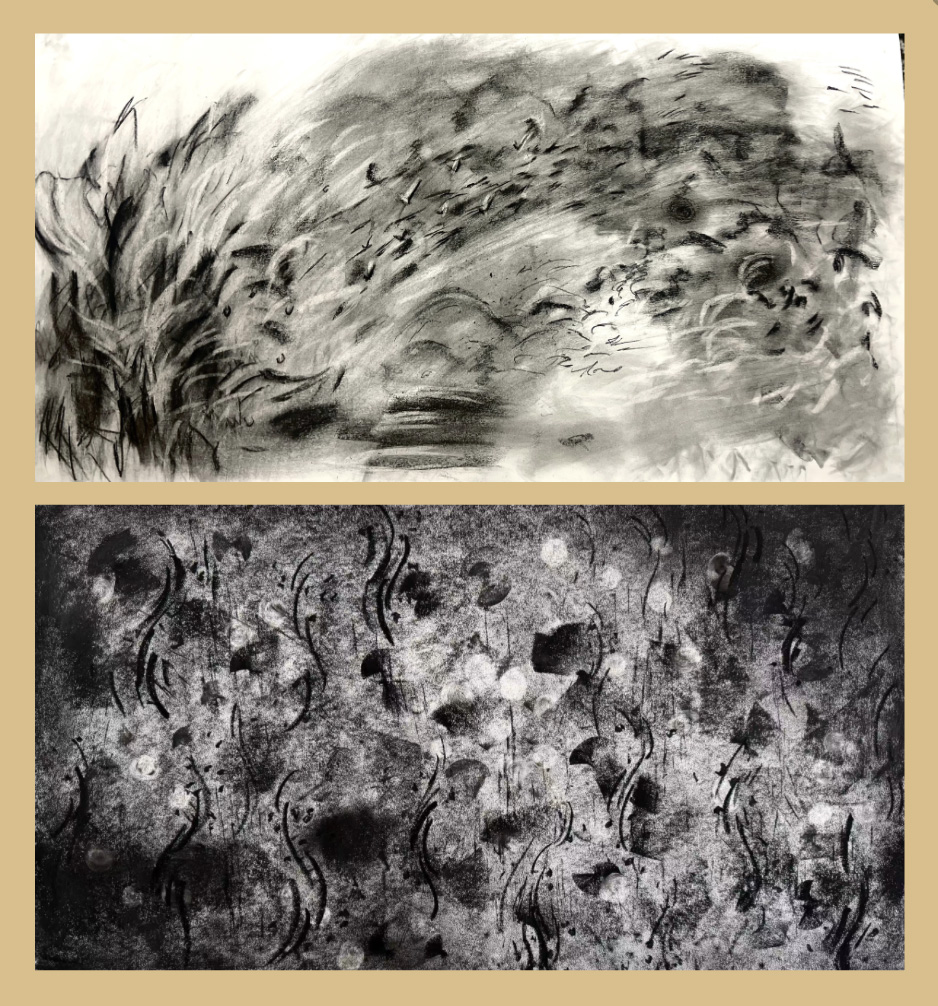
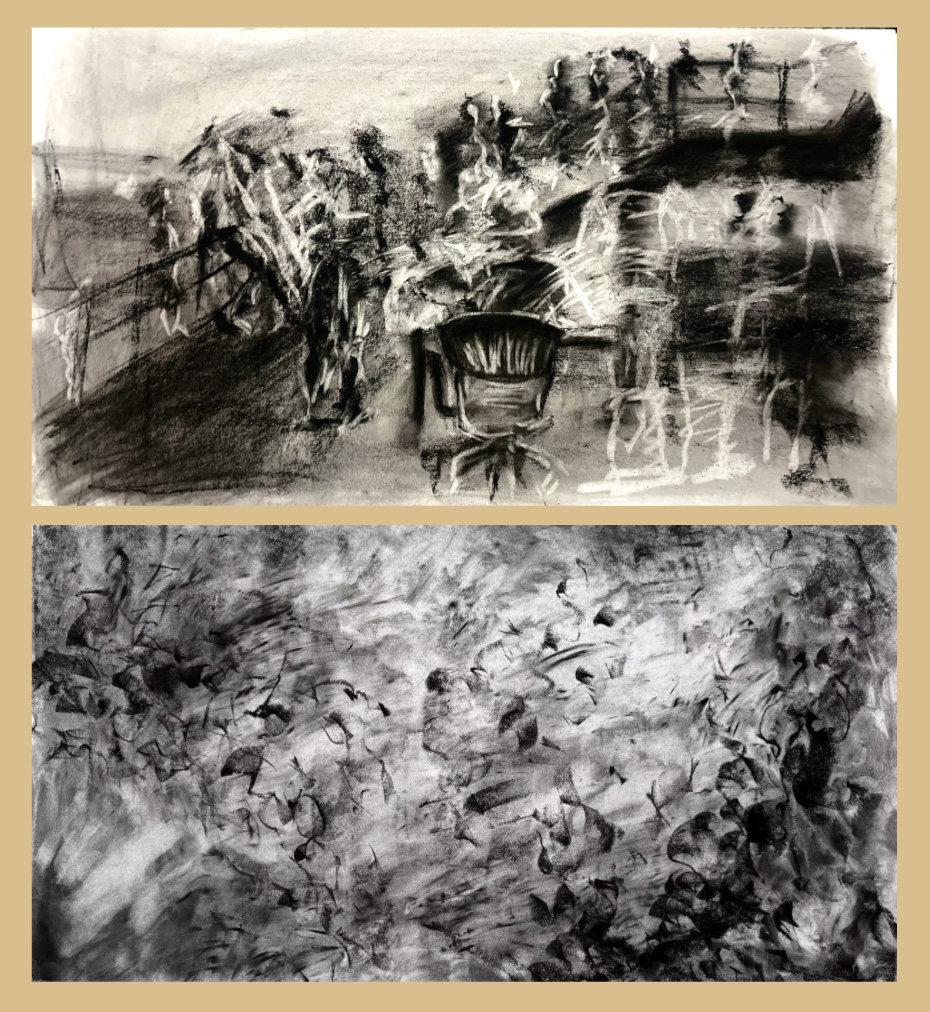
Traces, Esther Choi: The drawing (located higher up) facing the Chauhaus is composed entirely through sound. It was developed over two hours during Spring Break, when activity in the outer Tray was minimal and the Chauhaus was being cleaned and vacuumed. The swirling gestures on the left register the intensity and movement of the vacuuming, while diagonal lines extending across the page trace the rhythms of people ascending and descending the stairs. Dark squarish marks punctuate the composition, indicating the presence of individuals working in the Mezzanine space. The drawing facing the Mezzanine shifts from an auditory to a visual mode of perception. Here, the composition is grounded in observation rather than sound. Darkened tonal areas define the spatial boundaries of the Mezzanine and the bodies occupying it, while white erased marks trace the movement of people through the space. These erasures function as temporal imprints, capturing motion as an audible sequence of visual residues rather than as fixed forms.
Symphony Without Melody, Yue Duan: These two drawings (located lower down) depict the acoustical dimensions of the second floor Mezzanine above the Chauhaus, a common area with many tables where people gather and talk. The continuous operation of the Chauhaus refrigerators is the eternal background of the space, rough and coarse. Here, the sounds of chair wheels rolling on the ground, people chatting, and the intermittent footsteps of people going up the stairs can often be heard. Looking down at the Chauhaus, your hands may rest on the metal railing on which this exhibition is installed. The metal strings between the posts will make a melodious hum when you plunk them, as clear and beautiful as an instrument.
Occupied Air / Chauhaus Unseen
Krystal Huang (above) and Tina Zhang (below)
Location: Chauhaus, first floor
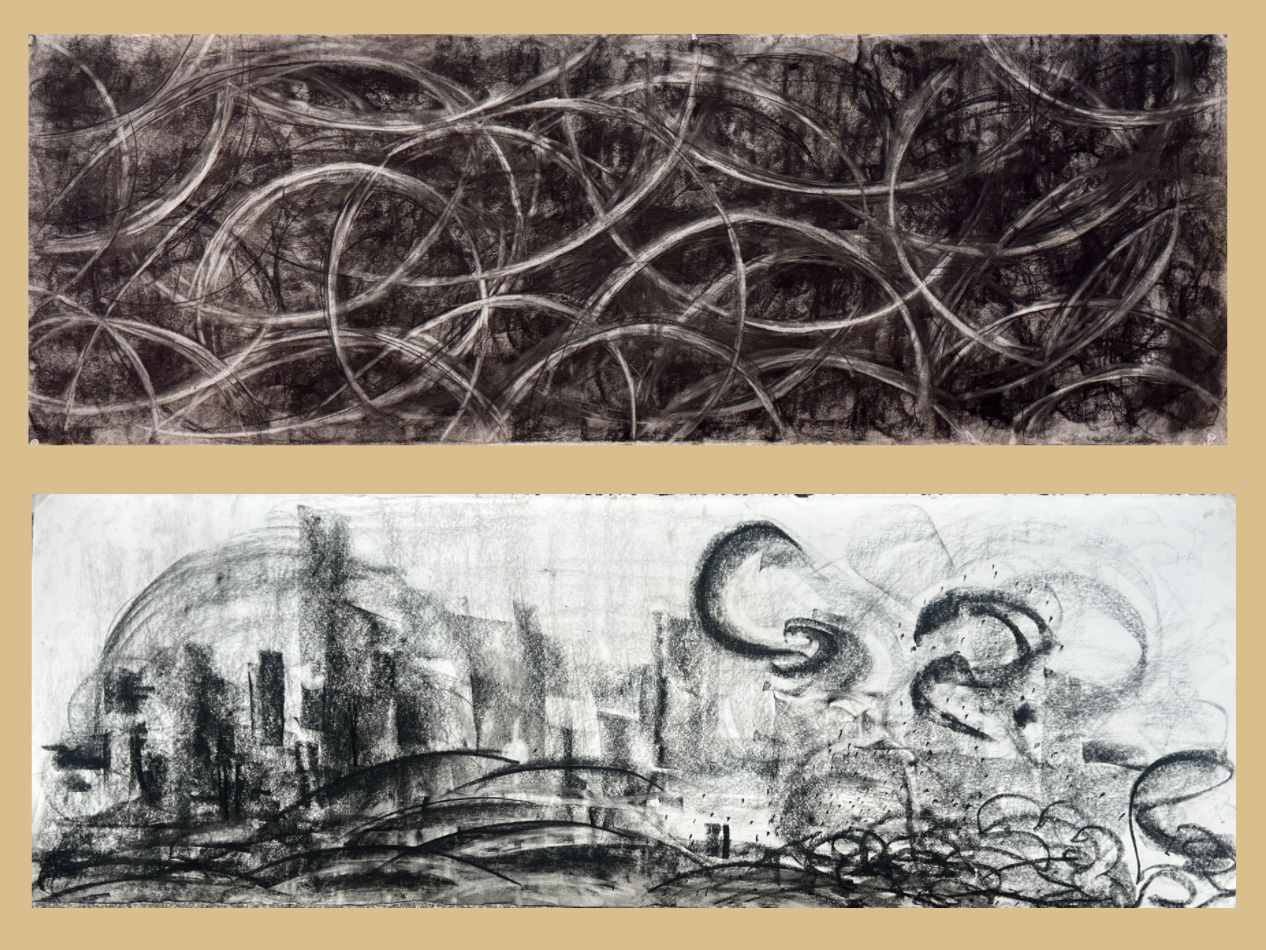
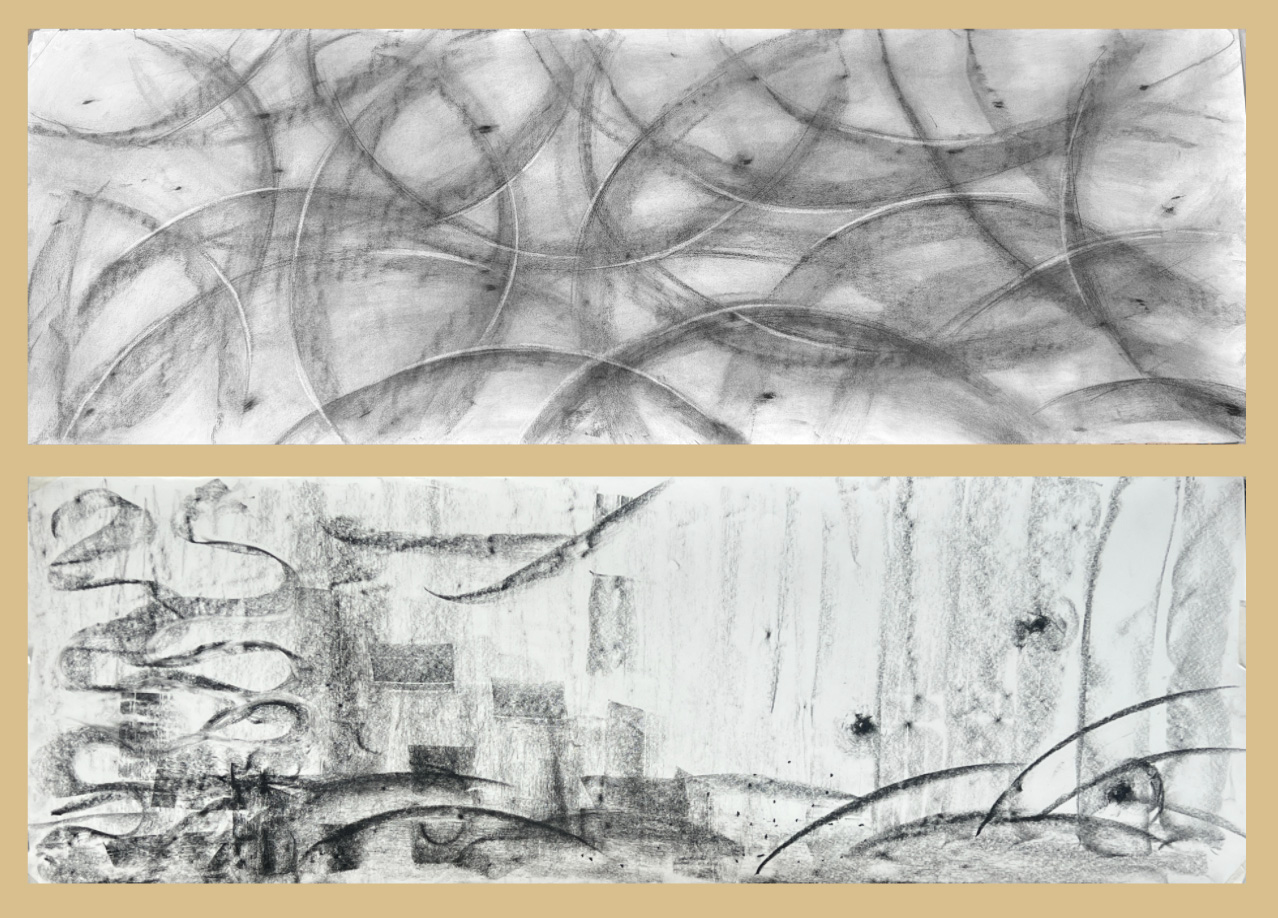
Occupied Air, Krystal Huang: These two drawings (located higher up) come from listening to the same place at different times of the day. I sat facing the Chauhaus food serving area both times, and I tried to draw what I heard. Layers of sound that gather, overlap, and fade in that space. At lunch, the sound feels thick and constant. Utensils hitting plates, people calling out orders, conversations crossing each other, everything stacks. The lines tangle and repeat because the sounds do too. There’s no clear separation between one noise and another. It becomes a continuous field, where individual sounds lose their edges and merge into a kind of pressure. At night, the same space sounds completely different. The lighter drawing feels more open, with gaps between lines. Sounds are still there – a chair moving, a quiet conversation, the hum of machines – but they don’t collide anymore. Each sound has space to exist on its own before fading. The lines stretch out, thinner and more scattered, following a slower rhythm. Nothing physically changes about the Chauhaus serving area, but the sound reshapes it. The dense and overlapping at noon, then loosened and almost drifting at night.
Chauhaus Unseen, Tina Zhang: These two drawings (located lower down) are visual interpretations of the soundscape of Chauhaus, captured at two distinct moments of the day. I positioned myself facing the condiment station, microwave, tissue stand, and trash area — the functional heart of the space — while absorbing the layered sounds from the dining tables and crowd behind. The drawing facing the Chauhaus responds to the busy, energetic noon period: the clatter of dishes, chatter, footsteps, and frequent use of appliances merge into a lively, bustling rhythm made visible. The drawing facing the Mezzanine depicts the quiet stillness of night: softened voices, faint ambient hums, and gentle, sparse movements create a calm, muted atmosphere.